
Get Zarr Variable
Usage
get_var(z, var, start = NA, count = NA, collapse = TRUE, unpack = FALSE, ...)

# S3 method for class 'character'
get_var(z, var, start = NA, count = NA, collapse = TRUE, unpack = FALSE, ...)

# S3 method for class 'NetCDF'
get_var(z, var, start = NA, count = NA, collapse = TRUE, unpack = FALSE, ...)

# S3 method for class 'ZarrGroup'
get_var(z, var, start = NA, count = NA, collapse = TRUE, unpack = FALSE, ...)

# S3 method for class '`NULL`'
get_var(z, var, start = NA, count = NA, collapse = TRUE, unpack = FALSE, ...)
Arguments
- z
an open ZarrGroup as returned by open_nz
- var
integer or character zero-based index id of variable of interest or name of variable of interest.
- start
integer vector with length equal to the number of dimensions of var. Uses R-style 1 indexing. If NA the entire array is returned.
- count
integer vector with length equal to the number of dimensions of var. Specifies the size of the returned array along the dimension in question. Can not be NA if start is not NA. NA count in one or more dimensions can be used to indicate all of a given dimension.
- collapse
logical if TRUE degenerated dimensions (length=1) will be omitted.
- unpack
logical if TRUE and the variable carries `scale_factor` and/or `add_offset` attributes, the returned values are unpacked as `(value * scale_factor) + add_offset`.
- ...
passed to RNetCDF var.get.nc
Examples
if(requireNamespace("pizzarr", quietly = TRUE)) {
z <- open_nz(z_demo())
latitude <- get_var(z, 0)
class(latitude)
dim(latitude)
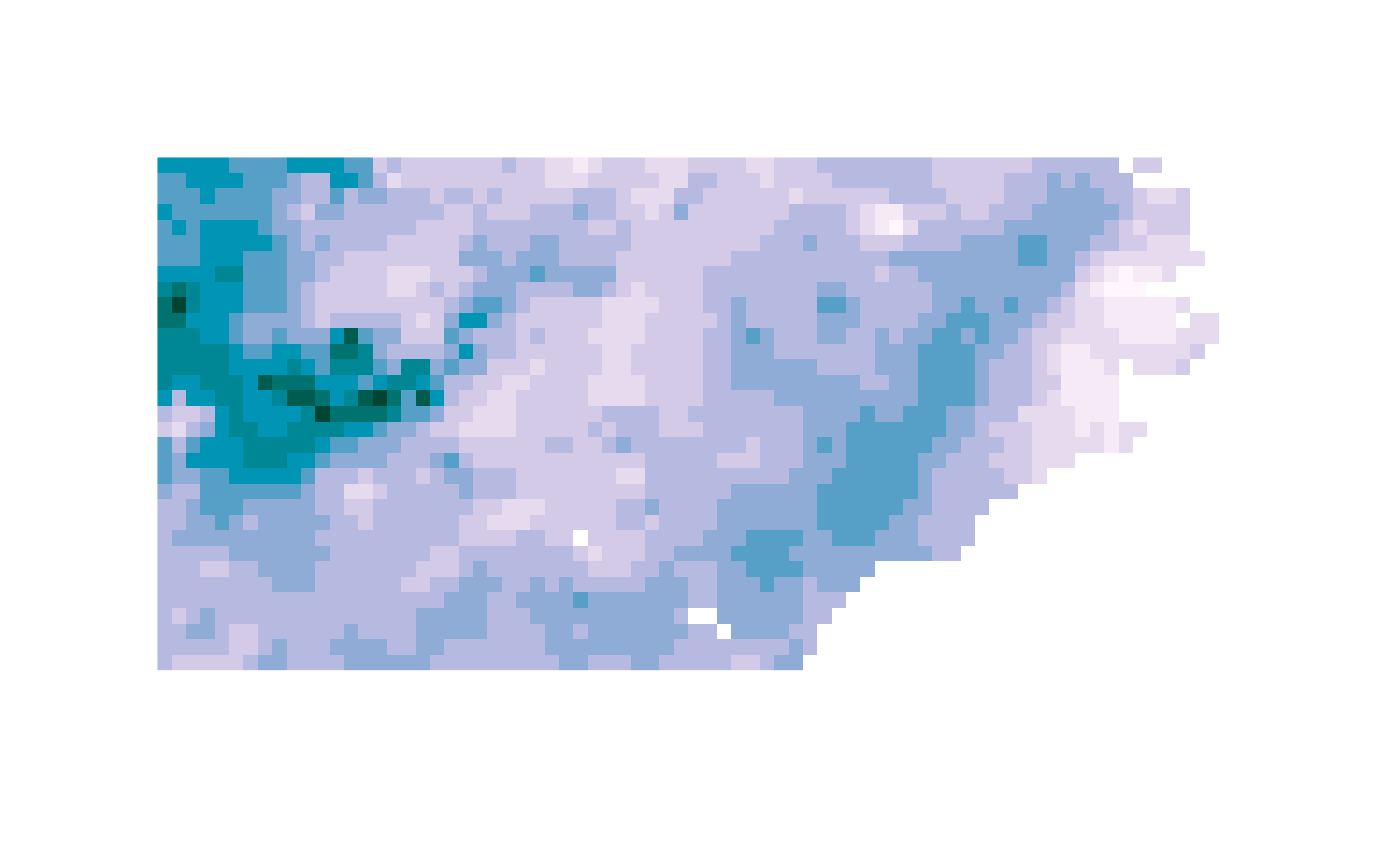
pr <- get_var(z, "pr") |>
aperm(c(3,2,1))
pr[pr > 1000] <- NA
image(pr[,,1], col = hcl.colors(12, "PuBuGn", rev = TRUE),
useRaster = TRUE, axes = FALSE)
dim(pr)
# subsetting
pr <- get_var(z, "pr", start = c(1, 1, 1), count = c(5, 5, -1))
dim(pr)
}
 #> [1] 5 5 81
# equivalent data in NetCDF
if(requireNamespace("RNetCDF", quietly = TRUE)) {
nc <- z_demo(format = "netcdf")
(get_var(nc, 0))
pr <- get_var(nc, "pr")
image(pr[,,1], col = hcl.colors(12, "PuBuGn", rev = TRUE),
useRaster = TRUE, axes = FALSE)
}
#> [1] 5 5 81
# equivalent data in NetCDF
if(requireNamespace("RNetCDF", quietly = TRUE)) {
nc <- z_demo(format = "netcdf")
(get_var(nc, 0))
pr <- get_var(nc, "pr")
image(pr[,,1], col = hcl.colors(12, "PuBuGn", rev = TRUE),
useRaster = TRUE, axes = FALSE)
}